Friday, February 8, 2019

1974 Topps #55 Frank Robinson

1974 Topps #55 Frank Robinson


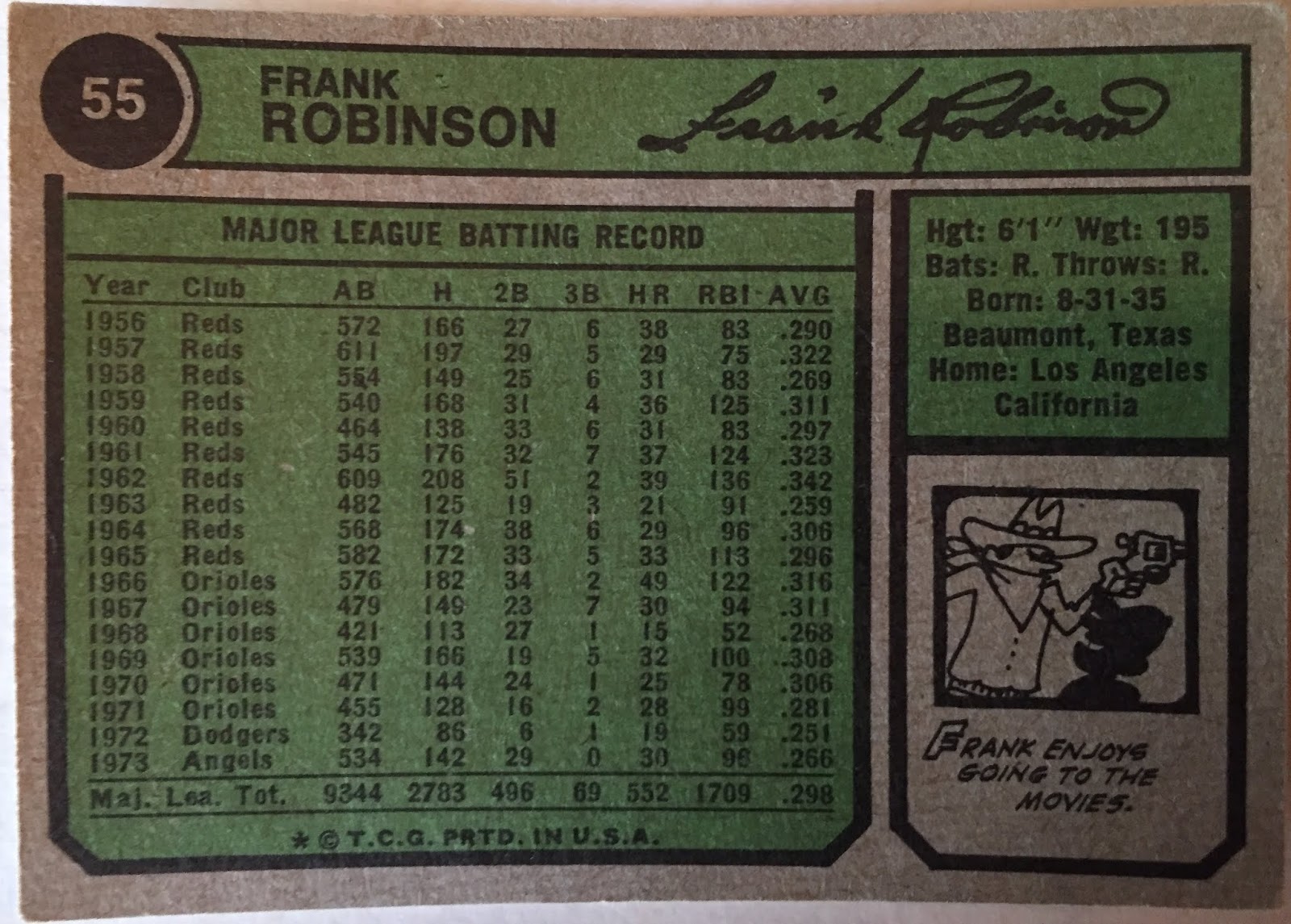
1974 Topps #55 Frank Robinson-back. That's a pretty impressive stat line.
One of the very best players in baseball history passed away yesterday. The great Frank Robinson was 83 years old. Throughout his long playing career, Robinson amassed numerous awards: Rookie of the Year, NL MVP, AL MVP, Triple Crown winner, 2-time World Series champion, first ballot Hall of Famer. Robinson also became baseball’s first African American manager, leading the Cleveland Indians in 1975. Robinson hung up his spikes after the 1976 season, but he remained in baseball his entire life, later managing the Giants, Orioles, and the Expos/Nationals. 

Robinson brought an intense competitive spirit to the diamond. Sportswriter Jim Murray memorably wrote that “Robinson always went into second like a guy jumping through a skylight with a drawn Luger.” (Needless to say, if he were still playing, Robinson would have some issues with the Utley Rule.) I’ve always felt that Frank Robinson was an underrated player. I know that sounds ridiculoushow can someone hit 586 home runs and be underrated? I think Robinson was somewhat overshadowed by Hank Aaron and Willie Mays. It’s really unfair to compare anyone to Hank Aaron and Willie Mays, and while Robinson falls short in the WAR comparison, at 107.3, compared to Aaron’s 143 and Mays’ 156.4, his slash line is very similar. (All stats according to Baseball-Reference.com)

Robinson: .294/.389/.537 OPS .926 OPS+ 154
Aaron: .305/.374/.555 OPS .928 OPS+ 155
Mays: .302/.384/.557 OPS .941 OPS+ 156

The lowest OPS+ that Robinson ever put up was 104, in his final season, 1976, in which he played just 36 games. His next lowest OPS+ was 118, in 1958. Robinson had one of the greatest single-seasons ever in 1966. In December of 1965, Robinson was traded from the Cincinnati Reds to the Baltimore Orioles for Milt Pappas, Jack Baldschun, and Dick Simpson. (Side note: Milt Pappas was actually a pretty good pitcher. He won 209 games and came within a strike of pitching a perfect game in 1972.) All Robinson had done for the previous decade was obliterate National League pitching, so why were the Reds dealing him? Well, in the words of General Manager Bill Dewitt, Robinson was “an old 30.” These words no doubt added fuel to Robinson’s already substantial competitive fire. In his first year with the Orioles, Robinson won the Triple Crown, leading the American League in home runs, RBI, and batting average. Not content to merely dominate the league in three prime statistical categories, Robinson also led the league in runs scored, on base percentage, slugging percentage, OPS, OPS+, total bases, and sacrifice flies. Robinson won the AL MVP, making him the first and only player to date to win the award in both leagues. The Orioles won the American League pennant that year, and faced the heavily favored Los Angeles Dodgers in the World Series. The Dodgers had a formidable 1-2 pitching punch with Sandy Koufax and Don Drysdale. However, the Orioles swept the Dodgers in four games. The score of Game 4? 1-0. How did the Orioles score that one run? On a Frank Robinson solo homer off of Don Drysdale. For his timely hitting, Robinson was awarded the World Series MVP. 

I met Frank Robinson once, at a baseball card show in 2013. He was very nice, easy to talk to, but a little intimidating all the same. He made eye contact with me a couple of times as I was standing in lineone guy was having trouble getting his cell phone to take a picture and Frank gave me an exasperated look like “You see what I have to deal with?” I also corrected the guy in front of me when he was talking about Frank’s 573 home runs. As Frank was signing the guy’s photo he looked at it and said, “Look at those guns, wow!” When I met Frank I told him he was one of my favorite players and I wish I could have seen him play. He said “You were born too late! You should have been born 20-30 years earlier. But if you’d been born then, you’d be old now like me.” I told him, “You’re not old,” and he gave me a funny look. I guess what I meant to say was “You’re only as old as you feel,” or something like that. So that was my interaction with the great Frank Robinson. I’m just happy I never had to pitch to him.

Monday, August 7, 2017

1989 Topps Don Baylor #673


1989 Topps Don Baylor, his last baseball card as a player.


1989 Topps Don Baylor, featuring his career stats.
I was saddened to hear that Don Baylor died today at the age of 68. Baylor was one of the great power hitters of the 1970’s and 1980’s. For Twins fans like me, Baylor will always be well known for his game-tying home run in Game 6 of the 1987 World Series. Baylor played in just 20 regular season games for the Twins in 1987, and ironically enough, didn’t hit a home run in any of those games. But he came through when the chips were down in the postseason. 

Baylor had a 19-year playing career, from 1970 to 1988. His best season came in 1979, when he was the AL MVP, leading the league in both runs scored and RBIs, and slugging a career-high 36 home runs for the California Angels. Baylor wasn’t a Hall of Famer, but he was an excellent player for many years, and he put up some pretty awesome career numbers. His 338 home runs are still good enough for 100th on the all-time list. To give you an idea of how the game has changed over the last 23 years, in 1994 he was 50th on the all-time home run list. Baylor also had good speed, as he stole 285 bases over his career, with a high of 52 for the Oakland A’s in 1976. Of course, no summary of Baylor’s career would be complete without mentioning his knack for getting hit with a pitch. Baylor was hit 267 times in his career, setting a modern-day record that Craig Biggio eventually broke.

I met Don Baylor at a baseball card show when I was a kid, it must have been shortly after he retired, probably 1989 or 1990. I can’t remember a lot about him, but I remember him being nice, and all of the pieces I’ve read about him today reinforced that he was truly a nice guy. The signed picture I have of him is with his second stop with the Oakland A’s, in 1988, when he achieved the unique distinction of playing in the World Series in 3 consecutive years with 3 different teams-1986 Boston Red Sox, 1987 Minnesota Twins, and the 1988 Oakland A’s. 

I read Don Baylor’s autobiography when I was a kid, but I can’t say I remember a lot about it. Autobiographies of baseball players made up a lot of my reading back in those days of my childhood. I’ve always been struck by how Don Baylor’s career is kind of a reverse image of Reggie Jackson’s. Granted, Baylor never climbed the ladder of super-duper stardom the way that Reggie did, but Baylor played for all of the same teams that Reggie did. Jackson and Baylor were part of the blockbuster trade that sent Reggie to the Orioles in April of 1976. Jackson played only one year for the Orioles, while Baylor only played one year for the A’s. While Reggie went to the Yankees and then to the Angels, Baylor went to the Angels and then to the Yankees. Jackson and Baylor were teammates for one year, on the 1982 Angels. Jackson led the AL in home runs that year with 39, while Baylor added 24 home runs of his own. Adding to the symmetry of their careers, both played their last season for the Oakland A’s, Jackson in 1987, Baylor in 1988. 

Don Baylor was a great baseball player, and his memory will continue to live on.

Monday, April 10, 2017

1957 Topps Roy Sievers #89


Roy Sievers, 1957 Topps.


Roy Sievers, 1957 Topps, back.
I know, the title of this blog is “Baseball Cards of the 1970’s and 1980’s,” and here the very first post is a card from the 1950’s. This blog is a side project of mine, so I don’t know how often I’ll post here. But I felt compelled to write about Roy Sievers, who passed away last week at the age of 90. I was born in 1981, so I obviously never saw Sievers play. I never even met him, and yet he was a baseball player I always liked. That’s part of the magic of baseball cards for me-you have connections to these players from the past through their cards. So players who played way before my lifetime are still a part of my history of the game. When I was a kid collecting old baseball cards, certain players just called out to me. I liked Julian Javier because of the alliteration of his name and the fact that he played for the Cardinals. I collected the cards of guys like Kurt Bevacqua and Mike Lum simply because I liked their names. 

Part of the reason I liked Roy Sievers was that he played for the Washington Senators, the franchise that moved to Minnesota for the 1961 season and became the Minnesota Twins. I’m from Minnesota, and a big Twins fan, so I have an affection for Senators players, even though the Twins never really do much to play up that part of their past. Unfortunately, Sievers was traded to the White Sox just before the 1960 season, so he never played for the Twins. 

Roy Sievers wasn’t a Hall of Famer, but he had a good, solid career. Born in St. Louis, he was signed by the St. Louis Browns in 1944. Military service put his professional career on hold until the 1947 season. After two years in the minors, Sievers made the Browns roster in 1949. He put together an excellent rookie season, batting a career-high .306. Sievers also put up 16 home runs and 91 RBIs, and he walked 70 times to post an OBP of .398. He ended up 9th in the league in batting average, 6th in slugging percentage, 7th in doubles, and 6th in RBIs. That production won Sievers the first American League Rookie of the Year award. In 1947 and 1948, the award was given to just one player, rather than one player from each league, and it was won by two National League players, Jackie Robinson and Al Dark. 

Baseball prognosticators thought Roy Sievers might be the next slugging sensation, but instead his career took a downward turn. He endured a dismal sophomore slump in 1950, batting just .238. Sievers then suffered a shoulder injury that limited him to only 42 games over the next two seasons. It looked as though Roy Sievers might be just another flash in the pan player who had a summer of glory and then came crashing back down to earth. After surgery on his shoulder and a position switch to first base, Sievers was able to play in 92 games for the Browns in 1953, and his batting stroke returned, as he hit .270. The Browns moved and became the Baltimore Orioles in 1954, but Sievers was traded to the Washington Senators before he ever suited up for the O’s. 

And that’s when Sievers’ career really took off. Playing in cavernous Griffith Stadium, Sievers’ power stroke returned and he clubbed 24 home runs in 1954, setting a Senators record that he would break each of the next three seasons. He also knocked in 102 RBIs. From 1954 to 1958, Sievers would rank among the top ten players of the American League in both home runs and RBIs.

Sievers’ greatest season was 1957, when he led the American League in home runs with 42, RBIs with 114, and total bases with 331. He finished third in the MVP voting that year, even though the lowly Senators finished in last place. 

Just before the 1960 season started, Sievers was traded to the Chicago White Sox. He had two excellent seasons with the White Sox before being traded to the Philadelphia Phillies. Sievers had two good years with the Phillies in 1962 and 1963. On July 19, 1963, Sievers became just the 22nd player in baseball history to hit 300 home runs. His 300th dinger was hit off Roger Craig, and it was a walk off in the bottom of the 9th, capping a 2-1 victory over the New York Mets. Sievers had a propensity for dramatic home runs: during his career he hit 10 pinch-hit home runs, 9 walk off homers, and 10 grand slams. In 1964, Sievers’ numbers started to slide. Hitting just .183 for the Phillies, he was sold to the expansion Washington Senators on July 16, 1964. A return to the city of his greatest triumphs was not enough to spark a rejuvenation of Sievers’ bat, and he was released by the Senators on May 15, 1965.

Roy Sievers had an excellent 17-year career in the major leagues. He hit 318 home runs and drove in 1,147 runs. Sievers had 4 seasons of more than 100 RBIs, which is the same number as Mickey Mantle. Sievers wasn’t a Hall of Famer, but he was a five-time All-Star. Sievers received votes for MVP in seven different seasons, and if he had played for a better team, he might have won the award in 1957. Sievers was stuck playing for second division teams, and he never appeared in the postseason. 

Sievers was Richard Nixon’s favorite baseball player when he was Vice President in the 1950’s, and Nixon even spoke at an event where the Senators honored Sievers. Sievers was also the batting double for actor Tab Hunter in the classic 1958 baseball musical Damn Yankees. From what I’ve read about Roy Sievers, it sounds like he was a very nice guy who enjoyed every moment of his major league career.